
Semmi is Rewriting the Rules of Personal Care


In beauty, we tend to celebrate the visible categories. Skincare gets the glow. Haircare gets the hero moments. Body care has finally had its renaissance. Hygiene, however, has largely remained in the aesthetic and formulation shadows.
Emily Griminger noticed.
What began as a deeply relatable personal frustration has evolved into Semmi, a flushable wipe brand positioning itself less as a bathroom afterthought and more as a modern personal care essential. For industry observers, the brand offers something particularly interesting: a case study in what happens when beauty-adjacent thinking enters one of the most overlooked corners of the routine.
Because the real story here is not wipes. It is category perception.
The Founder Lens
Griminger’s “aha” moment did not arrive in a lab or a trend report. It happened mid–New York City commute, the kind of lived experience insight that often produces the sharpest brands.
“As women, we are always wearing something form fitting. Between speed-walking and the subway, you are always sweating in some capacity,” she explains. “I started using wipes just to feel fresh throughout the day, but every product on the market either looked like it belonged in a nursery or had ingredient lists I could not even pronounce.”
For a consumer increasingly trained by skincare to scrutinize both design and formulation, the disconnect was obvious. The category had not kept pace with its user.
“I kept coming back to the same question. If we have elevated skincare, elevated body care, and elevated everything else in our routines, why is hygiene still stuck in the past? That disconnect was really the starting point for Semmi.”
It is a familiar pattern to those watching adjacent categories evolve. Consumer expectations move first. Product formats eventually follow.

Finance Brain Meets Founder Reality
Before Semmi, Griminger spent nearly a decade in banking and lending, a background that shows up less in the brand’s aesthetic and more in its operating posture.
The obvious skills translated cleanly: balance sheet fluency, comfort weighing debt, and a clear-eyed approach to go-to-market strategy. But the more durable founder traits came from somewhere else.
“The two skills I lean on almost every day are being endlessly resourceful and focusing my energy on the things I can actually control,” she says.
It is a mindset that feels particularly relevant in today’s bootstrapped landscape, where capital efficiency and operational discipline are once again back in fashion.
“As a solo founder with zero employees, figuring it out is a daily sport.”
Naming Beyond the Literal
In a category crowded with highly descriptive naming conventions, Semmi’s brand identity takes a more beauty-coded approach.
Griminger intentionally avoided centering the word “wipes,” instead pulling from a childhood nickname, Sweet Emi. The result is a name that feels more at home alongside skincare than in the paper goods aisle.
“I felt strongly that I did not want the word wipes to be the focus,” she explains. “Choosing a non-literal name allowed me to build a brand around care and community rather than just a butt wipe.”
The brand mission, she notes, is intentionally human: we have your back… and your front.
For industry professionals, the move reflects a broader shift. Functional categories increasingly borrow the emotional and aesthetic language of beauty in order to expand perceived value.

A Formula Built With Restraint
Where Semmi begins to mirror modern skincare most clearly is in formulation philosophy.
While the primary use case remains straightforward, Griminger pushed for a formula gentle enough to support multiple scenarios, from daily use to postpartum to after intimacy. The development process was iterative and, by her own admission, occasionally obsessive.
“I actually went through several formula iterations because I could not get comfortable with the harsher ingredients in the initial trials. It was quite literally keeping me up at night.”
The final composition is intentionally minimal: over 99 percent purified water, chamomile for its anti-inflammatory properties, and aloe for hydration and soothing. The wipes are fragrance free, alcohol free, plastic free, biodegradable, and made from 100 percent plant-based fibers.
In a category historically driven by cost efficiency over ingredient storytelling, the approach feels notably beauty-adjacent.

Addressing the Flushability Question Head-On
Flushable wipes remain one of the more scrutinized claims in personal care, and Semmi enters the conversation with a documentation-first posture.
Griminger’s manufacturing partner already held INDA GD4 and IWSFG certifications, but the brand pursued additional third-party testing specific to its final formula.
“I needed to know that every claim I made was true, especially regarding flushability and biodegradability,” she says. “Transparency is everything to me, so I want customers to have the facts.”
The wipes pass all seven tests outlined in the INDA GD4 guidelines, widely considered the gold standard for sewer and septic safety.
It is a strategic choice. In trust-sensitive categories, receipts often outperform rhetoric.
The Dispenser as Design Strategy
If the formula establishes credibility, the reusable dispenser is what gives Semmi its visual point of view.
Griminger was deliberate about creating an object that could live comfortably on the bathroom counter rather than being tucked away under the sink. It is here that the brand most clearly borrows from the playbook that transformed skincare packaging over the past decade.
“We spend so much time and money curating our skincare and home decor, yet our hygiene products are usually so ugly that we hide them,” she says. “The dispenser is truly an elevated accessory that you want to display.”
For industry watchers, the move signals a broader truth. As bathrooms become increasingly design-conscious spaces, even deeply functional products are being asked to earn their visual keep.

Normalizing the Conversation
Semmi’s tone strategy walks a careful line between approachability and polish, intentionally moving away from both the clinical language of medicated wipes and the infantilized cues of baby care.
“I wanted to remove the unspoken shame or embarrassment that often surrounds butt care,” Griminger explains. “Our visuals and tone are designed to feel sophisticated and empowering rather than juvenile or medicinal.”
The brand voice aims to feel like, in her words, a conversation with a friend who is not afraid to talk about the taboo parts of life.
It is a positioning choice that aligns with broader cultural shifts toward destigmatizing previously private wellness conversations.
Early Signals From the Market
Like many early-stage, bootstrapped brands, Semmi’s traction story is still unfolding, but early customer behavior is already offering interesting signals.
Griminger notes an unexpected cohort of mothers who initially purchased the dispenser for themselves and then repurposed it for toddler potty training. She has also seen conversion among consumers who did not previously consider themselves wipe users.
Both patterns point to an expandable use case, something many functional personal care brands quietly hope for but rarely achieve.
Growth to date has been driven primarily through organic social storytelling supported by modest Meta spend, with creator partnerships via ShopMy on the near-term roadmap. IRL activations, particularly in community-driven environments like workout classes and festivals, are also under consideration.
Building for the Long Game
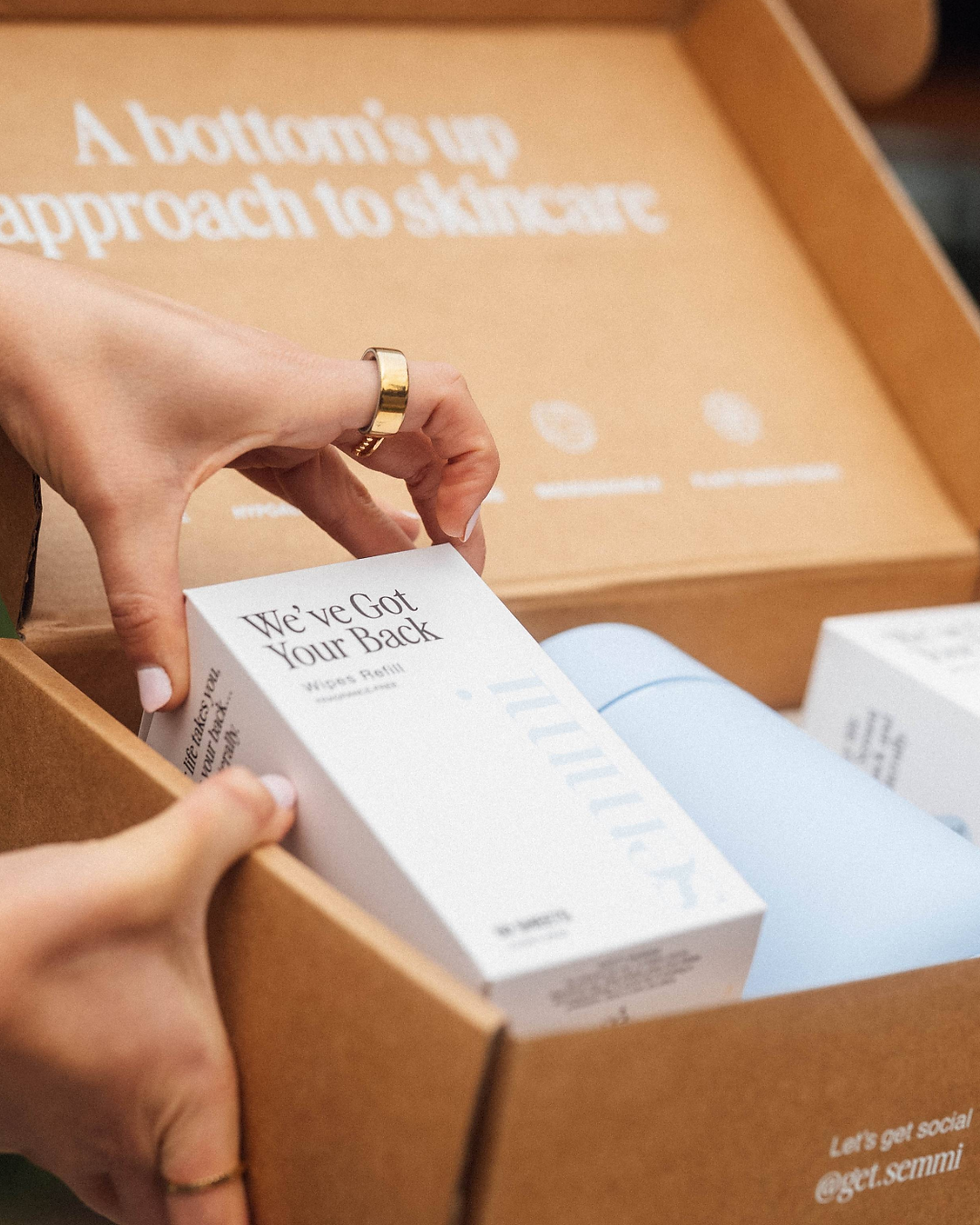
Semmi’s commercial strategy centers on a refill-first model, with the dispenser positioned as the initial investment and subscriptions designed to drive recurring revenue.
For Griminger, the structure is less about short-term spikes and more about long-term brand health.
“Subscriptions provide predictable growth, which is essential for a bootstrapped brand like Semmi. It gives us more stability to reinvest into the business.”
Retail expansion is also on the horizon, particularly in environments where the brand’s aesthetic can be experienced in context. Fitness studios, med spas, and boutique beauty retailers are early targets, spaces where hygiene already intersects naturally with self-care behavior.
The Myth She Would Retire
Ask Griminger what she wishes more founders understood, and her answer is notably grounded.
“One of the biggest myths is the idea that a single viral moment is the only metric for brand success,” she says. “True longevity comes from having a solid foundation of product quality and genuine customer trust.”
In a category that requires both education and behavior shift, the slow build may not just be prudent. It may be necessary.
The Bottom Line
Semmi is entering the market at an interesting moment, when consumers are increasingly applying beauty-level scrutiny to every corner of their routines. The brand’s bet is straightforward but smart: if hygiene is going to remain a daily essential, it should evolve alongside the rest of personal care.
Sometimes disruption is loud. Sometimes it is simply overdue.
Either way, Semmi is one to watch.
The Beauty Brief Recommends:


Comments